April 16 – June 28 2026 | Museum of Contemporary Art Tucson
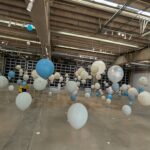
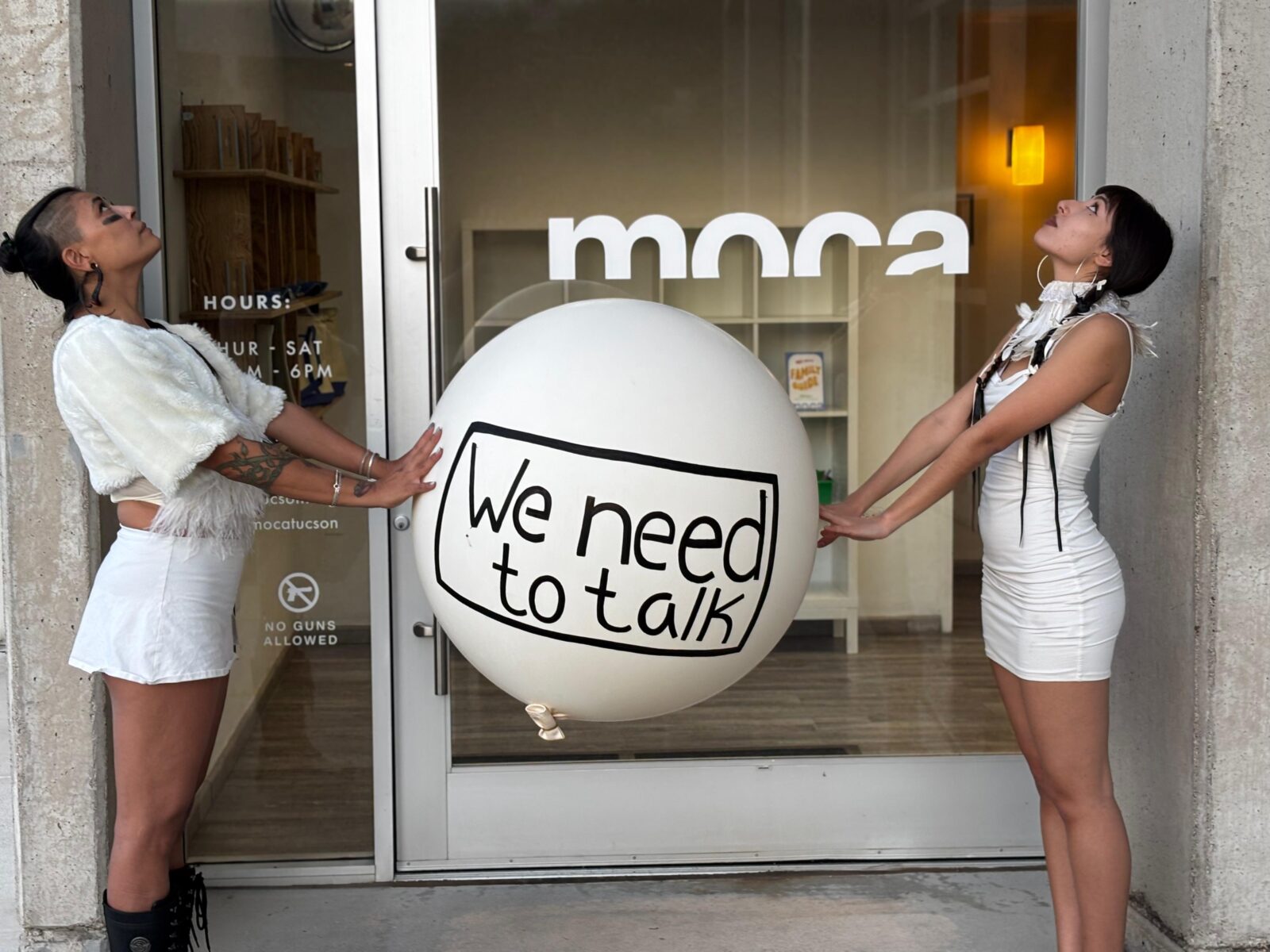
we need to talk is a large-scale installation by artist Natalie Brewster Nguyen that combines weather balloons, text, and audio to explore division and repair; celebration and excess; and the emotional and ecological impacts of human behavior. Situated in MOCA Tucson’s Great Hall and rooftop, a field of weather balloons drift through space with fragments of text shifting in meaning with each interaction and over time.
The phrase “we need to talk” signals an opening. It often occurs as a prelude to something heavy: a moment of confrontation or intervention, a difficult conversation, a conflict between individuals, a rupture that demands attention. It can be as intimate as a relationship break or as expansive as an unwanted life transition. The words carry a charge, and can elicit fear, trepidation, and anticipation all at once.
For the exhibition we need to talk, Nguyen reframes this enigmatic phrase as an invitation – a direct address to the audience drawing us into the work itself. In a time marked by deep division, misinformation, and a growing reliance on one-way forms of communication—such as online comments—the prompt asks us what it means to remain present with discomfort, and to engage in the difficult work of listening, and seeking resolution. The exhibition itself marks the closing chapter of Love Letters Leave No Trace, a collaborative project developed by Nguyen and her child over the last 15 years, in which they explored the environmental and emotional impacts of human celebration to ask what forms of excess and harm we excuse in the name of joy. Drawing inspiration from the spectacle and waste of children’s birthday parties, Love Letters examines the ecological consequences of celebration and explores dynamics of power and control between parent and child.
Nguyen explores these questions using balloons: symbols of whimsy as decoration in children’s birthday parties and celebrations, these objects simultaneously hold heavier histories as tools in wartime communication, early flight, and as ceremonial objects. Four large weather balloons are suspended above the roof of MOCA, each bearing a single word—WE NEED TO TALK—stretching the phrase across space as a declaration and demand. The Great Hall is filled with weather balloons of various sizes printed with fragments of text by the artist and close collaborators, drawn through processes of research and intuitive selection, accompanied by layered audio compositions.
Tethered by various objects, and slowly losing buoyancy over time, the field of balloons drift through the space, shifting in meaning as they encounter bodies, movements, breeze, and chance interactions, Nguyen asks: what would it mean to end our attachment to systems and behaviors that perpetuate harm—toward the planet and toward one another? Rather than avoiding conflict, Nguyen proposes “meaningful conflict” – a mode of engagement rooted in restoration, accountability, and repair. Ultimately, we need to talk resists closure and instead, it creates a condition shaped by the nature of the balloons: one in which the audience is implicated, language is unstable, and meaning is relational.
Ultimately, by creating a field of suspended language and breath, the artist asserts how this object is a symbol of human fragility and possibility: like a delicate membrane holding air, it mirrors our own tenuous existence—capable of holding wonder, contradiction, and awareness of mortality, while remaining sensitive to the forces around us.
Love Letters Leave No Trace is a multipart, many year performance and documentation project that explores the environmental, emotional, and psychological impact of human celebration. Inspired by the imagery of children’s birthday parties, Love Letters is a series of monochromatic ritualistic “love letters” in which balloons bearing text are spontaneously installed in a landscape by the daughter of the artist. These ritual performance installations are documented, and then carefully removed leaving no trace. The debris from the celebratory love letter is collected to be built into functional objects for later use.
Each chapter of the project explores a different color palette, period of childhood development, and text.